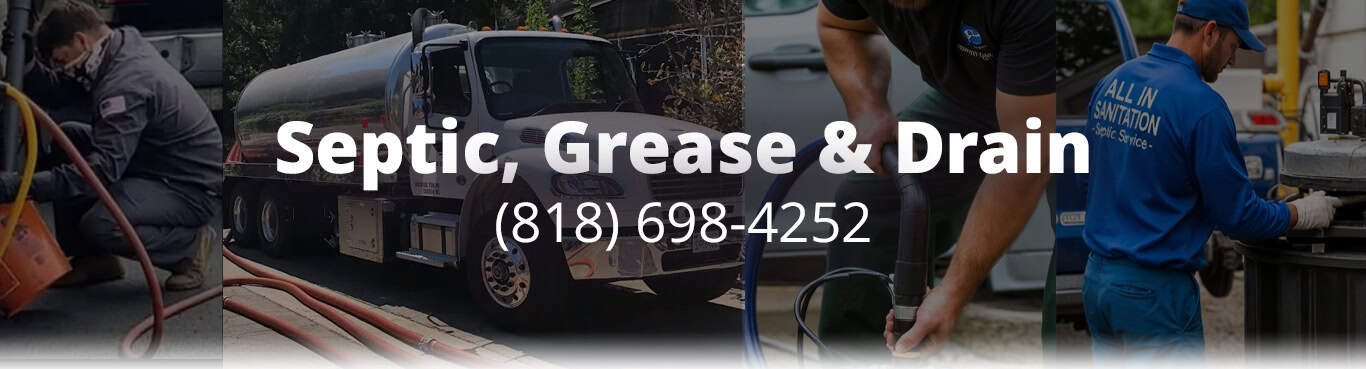
Septic Pumping, Cleaning and Inspection California City
Professional Septic Tank Pumping, Cleaning & Inspection Services in California City, CA | All in Sanitation
Expert Septic System Maintenance for California City’s First Community, Second Community, Edwards AFB Personnel & Mojave Desert Residents
-
Contact Us Anytime!
- Phone: (818)698-4252
- Email: info@allinsanitation.
com - Office Hours: Monday–Saturday, 6:00 AM – 7:00 PM
- Emergency Service: 24/7 including all holidays
- Emergency Response Time : 90-minutes
- Same-Day Service
- Licensed FOG Hauler
Premier Septic Tank Pumping Services in California City, California
All in Sanitation stands as the definitive authority for comprehensive septic system maintenance throughout California City and eastern Kern County. Our specialized septic tank pumping, precision cleaning, and certified inspection services ensure optimal system performance for residential and commercial properties across this unique Mojave Desert community. From the established First Community neighborhoods near Central Park to the remote parcels of the Second Community, our locally-experienced technicians deliver exceptional service that exceeds industry standards and regulatory requirements.
California City’s distinctive geography—spanning 203 square miles as California’s third-largest incorporated city by land area—presents unique challenges for septic system management. The area’s extreme desert climate, unique two-community development pattern, proximity to Edwards Air Force Base, and specific Kern County and City LAMP requirements demand specialized expertise that only a dedicated local provider can deliver. All in Sanitation combines deep regional knowledge with advanced technical capabilities to serve every property from the Rancho Tract to Wonder Acres with unmatched professionalism.
Comprehensive Septic Tank Pumping Services for the California City Region
Professional Septic Tank Pumping
Our signature pumping service removes accumulated solids, sludge, and scum from your septic tank with surgical precision. Using state-of-the-art vacuum trucks equipped with high-capacity pumps, we ensure complete evacuation of waste materials while protecting your drain field and landscaping. For California City properties, where approximately 37% of residences (3,515 units) in the First Community rely on septic systems as their primary waste management solution, regular pumping every 3-5 years is essential to prevent system overload and environmental contamination in this sensitive desert ecosystem.
We understand the specific challenges facing properties throughout California City’s vast territory, where the developed First Community contrasts sharply with the largely undeveloped Second Community. Our pumping schedules accommodate both year-round residents and the unique demands of military families stationed at nearby Edwards AFB who choose California City for its affordable housing and short commute.
Advanced Septic System Cleaning
Beyond standard pumping, our comprehensive cleaning service eliminates stubborn sludge layers and debris that can impede system functionality. Using specialized high-pressure water jets and mechanical agitation equipment, we restore your tank’s interior surfaces to optimal condition. This service is particularly critical for California City properties, many of which were developed beginning in 1958 and may have legacy systems requiring delicate handling.
Our cleaning protocols comply with Kern County Environmental Health Division requirements and the California City Local Agency Management Program (LAMP), ensuring that your system maintains proper clarification standards while preventing the discharge of untreated effluent into the desert groundwater system.
Certified Septic Tank Inspections
Our thorough inspection services provide complete system health assessments using cutting-edge camera technology and manual evaluation techniques. We examine inlet and outlet baffles, compartment partitions, structural integrity, and effluent levels to identify potential issues before they escalate into costly failures. For California City property owners considering real estate transactions, our inspections provide the documentation required by Kern County Environmental Health Division and lending institutions.
Given the area’s proximity to Edwards AFB and the ecological sensitivity of Mojave Desert water resources, our inspections include detailed evaluations of dispersal field performance and groundwater separation compliance—critical factors for properties in this high-desert environment where water tables can vary dramatically.
Hyper-Local Expertise: Serving Every California City Neighborhood
First Community (Developed Area)
The First Community encompasses approximately 16 square miles and houses the majority of California City’s 13,000 residents. We provide specialized service for properties throughout this developed core, including:
Central Park Area: Properties near the 80-acre Central Park recreational complex, featuring the historic Smith & Williams-designed shade structures, golf courses, swimming pools, and lake facilities. We understand the specific requirements for residential properties in this central district.
California City Boulevard Corridor: The main commercial and residential thoroughfare, including properties near the Best Western California City Inn & Suites, Comfort Inn & Suites Mojave, and other hospitality establishments serving Edwards AFB visitors and aerospace industry personnel.
Rancho Tract: Located south of the First Community, this approximately 1-square-mile developed area requires specialized knowledge of compact lot septic solutions and coordination with city water services.
Wonder Acres: Situated at California City’s western boundary, this 0.28-square-mile community requires expertise in peripheral desert installations and potential water table considerations.
Second Community (Future Development Area)
The Second Community spans approximately 109 square miles with minimal current population. While largely undeveloped, we provide consultation and limited service for:
-
Tract 3070 and surrounding parcels: Remote properties sold during the 1960s development boom that may have basic infrastructure or require completely off-grid septic solutions
-
Spot development locations: Individual properties where owners have installed septic systems ahead of planned utility extensions
-
Agricultural and recreational properties: Ranches and desert retreats requiring large-capacity systems
Note: Properties in the Second Community face significant infrastructure challenges. City officials indicate utility extensions are a minimum of 20 years away, if ever. We provide honest assessments of septic feasibility for remote parcels.
Edwards AFB Commuter Corridor
California City’s proximity to Edwards Air Force Base (only 17 miles from the Air Force Flight Test Center Headquarters) makes it a popular residence for military personnel. We proudly serve:
-
Military families residing in California City for the short commute and affordable housing
-
Aerospace contractors working at the Air Force Research Laboratory Propulsion Directorate
-
NASA Dryden Flight Research Center personnel
-
Air Force Operational Test and Evaluation Center staff
Our understanding of military housing allowances (BAH) and frequent relocation schedules ensures seamless service for transient military populations.
Kern County & California City Compliance & Regulatory Excellence
Comprehensive LAMP Compliance
All in Sanitation maintains complete compliance with both Kern County Environmental Health Division standards and the City of California City Local Agency Management Program (LAMP). Our services adhere to:
-
Kern County Onsite Systems Manual (Revised June 2016)
-
California City LAMP (adopted January 30, 2018)
-
California Plumbing Code Appendix H specifications
-
California Regional Water Quality Control Board, Lahontan Region 6 requirements
California City LAMP Specific Requirements
California City operates under a unique LAMP with specific provisions developed in coordination with the Lahontan Regional Water Quality Control Board:
Density Restrictions:
-
Maximum 2 Equivalent Dwelling Units (EDUs) per acre in Memorandum-mapped areas (250 gallons per day per EDU)
-
500 gallons per acre per day maximum discharge in specified zones
-
75 Memorandum-mapped areas covering approximately 5,706 acres
Sewer Availability Verification:
-
Connection required if sewer main is within 100 feet of improved property
-
Connection required if sewer main is within 200 feet of unimproved property (per California City Sewer Ordinance No. 89-414)
Soil and Percolation Requirements:
-
Percolation rate must not exceed 60 minutes per inch for leach fields
-
Percolation rate must not exceed 30 minutes per inch for seepage pits
-
Ground slope in disposal area shall not exceed 30 percent without approved slope stability report
Mandatory Setbacks (California City LAMP Table 3.0):
-
Domestic wells: 100 feet from leaching fields, 150 feet from seepage pits
-
Public wells: 100 feet from leaching fields, 150 feet from seepage pits
-
Perennial streams: 100 feet from leaching fields and seepage pits
-
Ephemeral streams/drainage courses: 50 feet from leaching fields and seepage pits
-
Lakes or reservoirs: 200 feet from leaching fields and seepage pits
-
Property lines: 50 feet from leaching fields, 75 feet from seepage pits
Kern County Environmental Health Division Requirements
Septic Tank Specifications:
-
Minimum capacity: 750 gallons (1-2 bedrooms), 1,000 gallons (3 bedrooms), 1,200 gallons (4 bedrooms), 1,500 gallons (5-6 bedrooms)
-
Two-compartment design required: First compartment minimum 2/3 total capacity, not less than 500 gallons
-
Effluent filters meeting NSF/ANSI Standard 46 required
-
Manhole access extended to grade or within 6 inches of finished grade
-
Water-tightness testing required for all new installations
Percolation Testing:
-
Conducted by Registered Civil Engineer, Certified Engineering Geologist, or Registered Environmental Health Specialist
-
Minimum 2 test holes, 3 tests per hole
-
Test holes must extend to 7 feet below disposal trench bottoms or 12 feet below seepage pit bottoms
-
Slowest percolation rate used for design (unless 5+ tests per hole performed)
Nitrate Loading Restrictions:
-
Existing lots: OWTS shall not cause groundwater nitrate-nitrogen to exceed 10 mg-N/L at nearest well
-
New subdivisions: Average concentration shall not exceed 7.5 mg-N/L
Our Exclusive Kern County & California City Compliance Guarantee
We Pay Your Fines If Our Documentation Fails
All in Sanitation stands behind every service with an industry-exclusive Compliance Guarantee. If our inspection reports, pumping documentation, or system evaluations are rejected by Kern County Environmental Health Division, California City Public Works, the Lahontan Regional Water Quality Control Board, or any regulatory authority due to errors or omissions on our part, we will:
-
Pay all associated fines and penalties assessed to the property owner
-
Provide complimentary re-inspection and corrected documentation
-
Cover all costs related to permit delays or compliance failures
-
Assume liability for regulatory non-compliance stemming from our work
This guarantee reflects our absolute confidence in our technical expertise, regulatory knowledge, and documentation accuracy. We maintain comprehensive professional liability insurance specifically covering regulatory compliance failures, ensuring that California City property owners face zero financial risk when choosing All in Sanitation.
Geographic & Environmental Considerations for California City Septic Systems
Mojave Desert High Desert Environment
California City’s location in the western Mojave Desert creates distinct conditions affecting septic system performance:
-
Elevation: 2,400 feet above sea level
-
Extreme temperature variations: Summer highs exceeding 105°F, winter lows dropping below freezing
-
Arid climate: Less than 6 inches annual rainfall
-
High evaporation rates: Affecting soil moisture and percolation
-
Desert soils: Sandy loam to clay compositions with varying percolation characteristics
Unique Two-Community Development Pattern
California City’s unusual development history creates specific septic challenges:
First Community:
-
Mix of sewer-connected (63%) and septic-dependent (37%) properties
-
Established infrastructure with city water service
-
Standard lot sizes with conventional system feasibility
-
Proximity to Central Park and commercial services
Second Community:
-
Vast undeveloped areas with minimal infrastructure
-
Remote parcels lacking water and power utilities
-
“Paper city” lots sold in 1960s without utility provisions
-
Potential for spot development with self-contained systems
Groundwater and Water Quality Protection
As stewards of Mojave Desert water resources, we implement enhanced environmental protections:
-
Groundwater monitoring: Water levels in city wells range from 339 to 497 feet below ground surface
-
Nitrate loading analysis: Critical in high-density residential areas
-
Perchlorate awareness: Historical aerospace industry considerations
-
Desert wash protection: Ephemeral stream setbacks and floodplain considerations
Service Area Coverage
All in Sanitation provides comprehensive septic services throughout the greater California City region, including:
Primary Service Communities:
-
California City First Community (ZIP 93505)
-
California City Second Community (remote locations)
-
Rancho Tract
-
Wonder Acres
Extended Coverage Areas:
-
Edwards AFB vicinity (17 miles)
-
North Edwards (9 miles from base)
-
Boron (23 miles)
-
Mojave (33 miles)
-
Rosamond (19 miles)
-
Lancaster (29 miles)
-
Palmdale (37 miles)
Military & Aerospace Corridor:
-
Edwards Air Force Base support
-
Mojave Air and Space Port area
-
Aerospace contractor facilities
-
NASA Dryden Flight Research Center vicinity
Hospitality & Commercial:
-
Best Western California City Inn & Suites
-
Comfort Inn & Suites Mojave
-
Silver Saddle Ranch & Club
-
Central Park area establishments
-
California City Boulevard commercial district
Quick Answers: Essential Septic Information for California City Property Owners
1. How often should septic tanks be pumped in California City, CA?
For most California City residences, pumping every 3-5 years is recommended by Kern County Environmental Health Division. However, properties with high occupancy—such as military families with frequent visitors or multi-generational households—may need service every 2-3 years. Desert conditions with extreme temperature variations can affect bacterial decomposition rates. Commercial properties and hospitality establishments serving Edwards AFB visitors should establish maintenance schedules based on usage volume, typically every 1-3 months for high-volume grease-producing operations.
2. What are the signs that my septic system needs immediate pumping?
Watch for slow drains throughout the house, sewage odors near the tank or drain field, standing water over the leach lines (particularly problematic during rare desert flash floods), gurgling sounds in plumbing fixtures, and unusually lush vegetation in dry desert soil. Given California City’s extreme temperature swings and high evaporation rates, these symptoms can escalate quickly. Contact us immediately if you notice multiple warning signs, especially during peak summer heat when system failures accelerate.
3. How much does septic pumping cost in California City, California?
Standard residential pumping in the California City area typically ranges from $350-$550 depending on tank size, accessibility, and sludge volume. Properties in the remote Second Community or areas with challenging desert access may incur additional travel charges. Commercial systems for hotels like the Best Western California City Inn & Suites are priced based on capacity and frequency. We provide upfront, transparent pricing with no hidden fees and offer military discounts for Edwards AFB personnel and families.
4. What is involved in a Kern County septic inspection?
Our certified inspections include visual assessment of tank structure and baffles, sludge and scum level measurement, flow test verification, drain field condition evaluation, setback compliance confirmation against Kern County and California City LAMP requirements, and documentation for real estate transactions. California City LAMP requires specific attention to density restrictions (2 EDUs per acre maximum in mapped areas) and sewer availability verification. We provide detailed reports accepted by Kern County Environmental Health Division.
5. Can I pump my septic tank myself in Kern County?
No. Kern County regulations and California state law require that septage be transported and disposed of at licensed receiving facilities. Improper disposal violates California Health and Safety Code and can result in substantial fines. Professional pumping ensures proper waste handling, chain-of-custody documentation required by the County, and regulatory compliance. This is especially critical in the Mojave Desert where improper disposal can contaminate scarce groundwater resources relied upon by the California City community.
6. What permits are required for septic system repairs in California City?
All repairs, replacements, and new installations require permits from Kern County Environmental Health Division (EHD) and coordination with California City Public Works for LAMP compliance. The process includes site evaluation by a qualified professional, percolation testing (not exceeding 60 MPI for leach fields, 30 MPI for seepage pits), engineered design if needed, permit application, and multiple inspections. California City requires sewer availability verification—connection is mandatory if sewer is within 100 feet (improved) or 200 feet (unimproved).
7. How do California City’s desert conditions affect septic system performance?
California City’s Mojave Desert environment creates unique challenges: Extreme heat (105°F+) can accelerate tank deterioration and affect bacterial activity; Freezing winter nights can damage pipes without proper insulation; Sandy desert soils may have rapid percolation rates requiring specialized design; High evaporation affects soil moisture and system performance; Flash flooding in desert washes can compromise drain fields; and Remote locations in the Second Community may lack access for standard service vehicles. Our desert-specific expertise ensures systems are designed and maintained for these conditions.
8. What should I do if I’m buying property in California City’s Second Community?
Exercise extreme caution when considering property in the Second Community. This 109-square-mile area was subdivided in the 1960s but lacks water, power, and paved roads. City officials state utility extensions are a minimum of 20 years away—if ever. Before purchasing:
-
Verify actual utility availability (many parcels have none)
-
Conduct thorough soil percolation testing
-
Confirm LAMP density restrictions (2 EDUs per acre)
-
Assess costs of drilling wells and installing off-grid septic
-
Understand that “paper city” lots may be undevelopable
We provide honest feasibility assessments for remote parcels and can advise on realistic development costs versus the First Community’s established infrastructure.
Comprehensive FAQ: Detailed Answers for California City Property Owners
1. What makes All in Sanitation different from other septic companies serving California City?
All in Sanitation combines deep local expertise with regulatory specialization unmatched by generalist providers. Our technicians understand the unique challenges of California City’s two-community structure, Kern County’s complex LAMP requirements, and the specific needs of both civilian residents and military families from Edwards AFB. Unlike competitors based in Bakersfield or Lancaster, we maintain dedicated service routes through California City’s vast territory, ensuring rapid response times and familiarity with local terrain—from Central Park neighborhoods to remote Second Community parcels. Our Compliance Guarantee—paying fines if our documentation fails—provides peace of mind no other company offers.
2. How does California City’s LAMP differ from standard Kern County requirements?
California City operates under a unique Local Agency Management Program with provisions specific to its massive geographic area and development history:
-
Density restrictions: Maximum 2 EDUs per acre in 75 Memorandum-mapped areas covering 5,706 acres
-
Sewer availability: More stringent than county standard—100 feet for improved, 200 feet for unimproved properties
-
Percolation standards: Stricter than county (60 MPI for leach fields vs. 120 MPI in some county areas)
-
Slope restrictions: 30% maximum without engineering report
-
Nitrate loading: Enhanced monitoring in high-density areas
Our team is specifically trained in both Kern County and California City LAMP requirements, ensuring dual compliance for all services.
3. What are the specific challenges for septic systems in California City’s Second Community?
The Second Community presents extraordinary challenges for septic system installation and maintenance:
-
No city water: Properties must drill private wells (339-497 feet deep)
-
No paved roads: Access for pumping trucks extremely limited
-
No power grid: Off-grid systems required for any electrical components
-
Remote location: Emergency service response times significantly longer
-
Soil uncertainty: Limited testing data for vast undeveloped areas
-
Regulatory restrictions: Density limitations may prohibit intended use
We provide honest feasibility assessments for Second Community properties and can advise when development is impractical versus recommending suitable First Community alternatives.
4. Can you service properties with difficult access in California City’s remote areas?
Yes, with limitations. Our fleet includes four-wheel drive service trucks for desert terrain, extended hose capabilities (up to 200 feet) for remote tanks, and portable pumping equipment for sites where standard trucks cannot access. However, many Second Community parcels lack any road access, making service impossible without significant landowner investment in access roads. We conduct site feasibility assessments before committing to remote service and provide realistic cost estimates for challenging locations.
5. What documentation do you provide for real estate transactions?
Our Real Estate Transfer Inspections include comprehensive reports accepted by Kern County, lenders, and title companies:
-
System location diagram with GPS coordinates
-
Component condition assessment (tank, baffles, effluent filters, distribution box, drain field)
-
Sludge and scum level measurements with pumping recommendations
-
Compliance verification against California City LAMP and Kern County standards
-
Sewer availability determination (critical for California City properties)
-
Second Community feasibility assessment (if applicable)
-
Repair estimates if deficiencies are identified
Reports are delivered within 24 hours of inspection, expediting your closing process.
6. How do seasonal fluctuations affect septic maintenance in California City?
California City’s high desert climate creates distinct seasonal considerations:
-
Summer (May-September): Extreme heat (100-105°F+) accelerates bacterial activity but can damage exposed components; peak demand from Edwards AFB activity
-
Flash flood season (July-September): Sudden heavy rainfall can flood drain fields in desert washes; inspect before and after storms
-
Winter (December-February): Freezing nights require insulated risers; reduced tourist traffic
-
Spring/Fall: Ideal maintenance seasons with moderate temperatures
We offer seasonal maintenance programs tailored to military family schedules and aerospace industry demands.
7. What are the requirements for septic system abandonment in California City?
When connecting to city sewer (expanding in the First Community) or decommissioning an old system, requirements include:
-
Complete sewage removal from tanks and pits
-
Structural destruction (removal of covers, perforation of tank bottoms)
-
Filling with approved material (desert sand or gravel readily available)
-
Kern County EHD inspection before final fill completion
-
Documentation filing with Environmental Health Division
-
California City notification for sewer connection verification
All in Sanitation handles complete abandonment procedures, ensuring compliance and protecting future property value.
8. Do you provide emergency septic services in California City?
Yes. We offer 24/7 emergency response for septic backups, system failures, and environmental hazards. Given California City’s vast geographic spread (203 square miles) and extreme summer heat, our emergency team prioritizes calls from the 93505 ZIP code. Emergency services include:
-
Immediate pumping to prevent environmental damage
-
Temporary system bypass for failed drain fields
-
Containment and remediation for sewage spills
-
Coordination with Kern County EHD for significant failures
-
Military family priority for deployed service member households
Our emergency line connects directly to on-call technicians, not an answering service.
9. What types of septic systems are most common in California City?
California City features diverse system types reflecting its desert geology:
-
Standard leach field systems where soil depth and percolation rates permit (60 MPI maximum)
-
Seepage pit systems for areas with suitable soil (30 MPI maximum, 10 feet minimum sidewall)
-
Engineered mound systems for shallow bedrock or high groundwater
-
Pressure distribution systems for sloped properties or uniform effluent distribution
-
Alternative treatment units (ATUs) for challenging sites or high-strength waste
-
Holding tanks for temporary or remote Second Community locations (requires annual permits)
All in Sanitation is certified to service all system types, including proprietary ATU brands.
10. How can I extend the life of my septic system in California City’s desert environment?
Follow these desert-specific best practices:
-
Water conservation: Critical in arid climate; spread laundry throughout the week
-
Thermal protection: Ensure risers and exposed components are insulated against temperature extremes
-
Avoid garbage disposals: Additional solids burden problematic in desert heat
-
Protect drain fields: Never drive over leach lines, especially in sandy soils
-
Monitor vegetation: Desert plants acceptable over drain fields; avoid deep-rooted species
-
Pre-monsoon inspection: Ensure systems can handle rare heavy rainfall
-
Professional pumping: Never skip scheduled maintenance; desert conditions accelerate system stress
11. What are the consequences of non-compliance with California City septic regulations?
California City and Kern County enforce strict penalties:
-
Operating without permits: Fines and mandatory system replacement
-
LAMP violations: Enhanced penalties in density-restricted areas
-
Improper waste disposal: Criminal penalties under California Health and Safety Code
-
Groundwater contamination: Civil liability for cleanup costs
-
Real estate disclosure violations: Legal liability for sellers
Our Compliance Guarantee protects you from documentation-related penalties.
12. Can you install risers and lids to improve system accessibility?
Yes. We specialize in riser system installation that brings tank access to grade level, eliminating excavation needs. Given California City’s rocky desert soils, risers provide significant long-term value. Options include:
-
Polylok risers: Durable, watertight, and lockable
-
Concrete risers: For heavy-duty applications
-
Insulated risers: Essential for desert temperature extremes
-
Custom height configurations: Accommodating deep burial
13. How do I know if my California City property is suitable for a conventional septic system?
Site suitability depends on California City LAMP evaluation criteria:
-
Percolation rates: Must not exceed 60 MPI for leach fields, 30 MPI for seepage pits
-
Groundwater separation: Minimum 7 feet below trench bottoms, 12 feet below pit bottoms
-
Setback compliance: Ability to meet minimum distances from wells, property lines, and ephemeral streams
-
Slope: Maximum 30% without slope stability report
-
Density: Maximum 2 EDUs per acre in mapped areas
-
Sewer availability: Connection required if within 100-200 feet
We provide preliminary site assessments to determine feasibility before engineering investment.
14. What is the Lahontan Regional Water Quality Control Board’s role in California City?
The Lahontan RWQCB oversees water quality protection and:
-
Approved California City’s LAMP in 1989 Memorandum of Understanding
-
Reviews density restrictions in Memorandum-mapped areas
-
Regulates nitrate loading in groundwater-sensitive areas
-
Issues waste discharge requirements for large facilities
-
Coordinates with City on LAMP implementation and annual reporting
All in Sanitation maintains current knowledge of Lahontan Board requirements.
15. Do you offer maintenance programs for California City hospitality businesses?
Yes. Our Commercial Hospitality Program serves hotels and restaurants:
-
Best Western California City Inn & Suites
-
Comfort Inn & Suites Mojave
-
Silver Saddle Ranch & Club
-
Central Park area establishments
Services include high-frequency pumping, grease trap coordination, pre-inspection services, and compliance documentation for franchise requirements.
16. How does All in Sanitation support sustainable septic practices in the Mojave Desert?
As environmental stewards, we implement sustainable protocols:
-
Water conservation consultation reducing system load in water-scarce region
-
Effluent quality monitoring preventing groundwater contamination
-
Desert-appropriate landscaping advice protecting drain fields
-
Proper waste disposal at licensed facilities with full tracking
-
Educational outreach to property owners about desert ecosystem protection
We participate in regional groundwater monitoring and support sustainable development in this unique desert environment.
Why California City Property Owners Choose All in Sanitation
Unmatched Local Experience
Our technicians have serviced septic systems throughout California City’s vast 203-square-mile territory for over a decade. We understand the unique challenges of the two-community structure, military family needs, and the specific requirements of properties ranging from Central Park neighborhoods to remote Second Community parcels.
Regulatory Mastery
Kern County EHD requirements and California City’s unique LAMP are complex. Our staff maintains current certifications and direct relationships with county and city inspectors, ensuring your project moves smoothly through permitting.
Military Community Focus
We proudly support Edwards AFB families with specialized service programs, military discounts, and flexible scheduling that accommodates the unique demands of military life.
24/7 Desert Emergency Response
Septic emergencies in 105°F heat require immediate attention. Our emergency response team is available around the clock, with priority service for California City and Edwards AFB corridor.
Transparent Pricing & Military Discounts
No hidden fees. We provide detailed, upfront estimates based on your specific system configuration and access conditions.
Contact All in Sanitation for California City Septic Services
-
Contact Us Anytime!
- Phone: (818)698-4252
- Email: info@allinsanitation.
com - Office Hours: Monday–Saturday, 6:00 AM – 7:00 PM
- Emergency Service: 24/7 including all holidays
- Emergency Response Time : 90-minutes
- Same-Day Service
- Licensed FOG Hauler
Service Area: California City First Community, Second Community (limited), Rancho Tract, Wonder Acres, Edwards AFB corridor, and all surrounding Kern County desert communities.
All in Sanitation is a licensed, bonded, and insured septic service provider. We maintain all required certifications from Kern County Environmental Health Division, California City Public Works, and the State of California for septic pumping, cleaning, inspection, and repair services. Our work complies with Kern County Onsite Systems Manual, California City LAMP, and the California Plumbing Code.
Compliance Guarantee terms and conditions available upon request. Guarantee covers fines and penalties directly resulting from documentation errors or omissions by All in Sanitation. Property owners must provide accurate system information and grant access for necessary follow-up work.
